Pearson Edexcel · GCSE · English Language
Course version: 1EN0 · Version from Mar 2026
Fiction and Imaginative Writing - 1.1 Reading: 1.1.1 read and understand a…
Full specification wording
Component 1: Fiction and Imaginative Writing - 1.1 Reading: 1.1.1 read and understand a range of prose fiction, including unseen texts
This skill is about reading unseen prose fiction and making sense of it quickly and accurately.
Checked against the Pearson Edexcel 1EN0 specification (opens in a new tab) on .
- Point 1 of 4
- 4 key terms
Study notes
From the checked teaching notes for this specification point.
The idea
This skill is about reading unseen prose fiction and making sense of it quickly and accurately. You need to follow what happens, who is involved, where and when events take place, and what the text suggests beneath the surface. Start by skimming for the gist, then scan for key details such as character names, setting, conflict and resolution. For example, in an unseen 19th-century extract, note the narrator, the main problem and any shifts in mood. Use annotation to track plot, character and setting. Understanding means you can explain explicit information and also infer what is suggested, such as a character's feelings or motives. You should be able to summarise a passage accurately and select short quotations that support your points. This comprehension underpins later analysis, so practise reading a variety of prose fiction from different periods and genres.
Common mistakes and how to put them right
Retelling the whole story instead of answering the question.
Put it right: Select only the details that directly address the focus and explain what they show.
Copying long quotations without explanation.
Put it right: Embed short quotations and explain what each word or phrase suggests.
Ignoring the opening or ending of the extract.
Put it right: Track how the text develops and refer to shifts in focus, mood or tension.
Exam tips
- Read the question first, then annotate the extract with brief labels for plot, character, setting and implied meaning.
- Plan two or three clear points, each supported by a short quotation and a comment on what it suggests.
- Keep an eye on time: allocate a few minutes to reading and planning before writing your response.
Try the lesson
The start of the Component 1: Fiction and Imaginative Writing - 1.1 Reading: 1.1.1 read and understand a range of prose fiction, including unseen texts lesson, made from checked teaching notes for this specification point.
Have a go first
Read this sentence from an unseen story: 'Maya pulled her coat tighter, her breath forming white clouds in the still air as she hurried past the shuttered shops.' What does this sentence tell you about the weather?
Listen
This skill is about reading unseen prose fiction and making sense of it quickly and accurately. You need to follow what happens, who is involved, where and when events take place, and what the text suggests beneath the surface. Start by skimming for the gist, then scan for key details such as character names, setting, conflict and resolution. For example, in an unseen 19th-century extract, note the narrator, the main problem and any shifts in mood. Use annotation to track plot, character and setting. Understanding means you can explain explicit information and also infer what is suggested, such as a character's feelings or motives. You should be able to summarise a passage accurately and select short quotations that support your points. This comprehension underpins later analysis, so practise reading a variety of prose fiction from different periods and genres. A common slip: Retelling the whole story instead of answering the question. Instead, select only the details that directly address the focus and explain what they show. Exam tip: Read the question first, then annotate the extract with brief labels for plot, character, setting and implied meaning.
See it
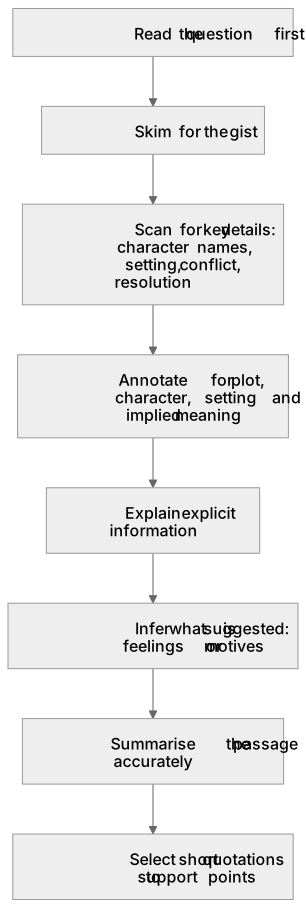
Put it in order
Put these steps in the order they happen.
- 1. Explain explicit information
- 2. Select short quotations to support points
- 3. Infer what is suggested: feelings or motives
- 4. Read the question first
- 5. Skim for the gist
- 6. Summarise the passage accurately
- 7. Scan for key details: character names, setting, conflict, resolution
- 8. Annotate for plot, character, setting and implied meaning
Watch it explained
What is the one idea the video explains? Say it in a sentence.
Read the described scene instead
This lesson focuses on reading unseen prose fiction for Pearson Edexcel GCSE English Language. The aim is to make sense of a passage quickly and accurately. You will follow what happens, who is involved, where and when events take place, and what the text suggests beneath the surface. Comprehension has two sides. Explicit meaning is information stated clearly, while implicit meaning is what is suggested. You also need to interpret character, setting and atmosphere, and to summarise and infer accurately. These reading skills underpin later analysis. Read the question first. Then skim for the gist and scan for key details such as character names, setting, conflict and resolution. Annotate briefly to track plot, character, setting and implied meaning. Imagine an unseen nineteenth-century extract. The source advises noting the narrator, the main problem and any shifts in mood. Pause briefly and decide which details you would select. If the question asks about a character's feelings, choose a short quotation and explain what it suggests, rather than retelling the whole story. Three common mistakes are retelling the whole story, copying long quotations without explanation, and ignoring the opening or ending. Instead, select details that directly address the focus, embed short quotations, and explain what each word or phrase suggests. Track how the text develops and refer to shifts in focus, mood or tension. To recap, read unseen prose fiction for explicit and implicit meaning. Interpret character, setting and atmosphere, select short textual evidence, and summarise accurately. Plan two or three clear points, each supported by a short quotation and a comment on what it suggests. Allocate a few minutes to reading and planning before writing.
Key words
Say what each word means before you turn the card.
Comprehension of explicit and implicit meaning
Try answering aloud or in your head before turning the card.
Interpretation of character, setting and atmosphere
Try answering aloud or in your head before turning the card.
Selection and use of textual evidence
Try answering aloud or in your head before turning the card.
Summarising and inference
Try answering aloud or in your head before turning the card.
See every definition
- Comprehension of explicit and implicit meaning
- Explaining information that is stated directly and also inferring what is suggested, such as a character's feelings or motives.
- Interpretation of character, setting and atmosphere
- Following who is involved, where and when events take place, and noting any shifts in mood.
- Selection and use of textual evidence
- Selecting short quotations that support your points and explaining what each word or phrase suggests.
- Summarising and inference
- Skimming for the gist, scanning for key details, and summarising a passage accurately while inferring what lies beneath the surface.
Label the diagram
Some boxes have lost their names. Pick the right name for each number.
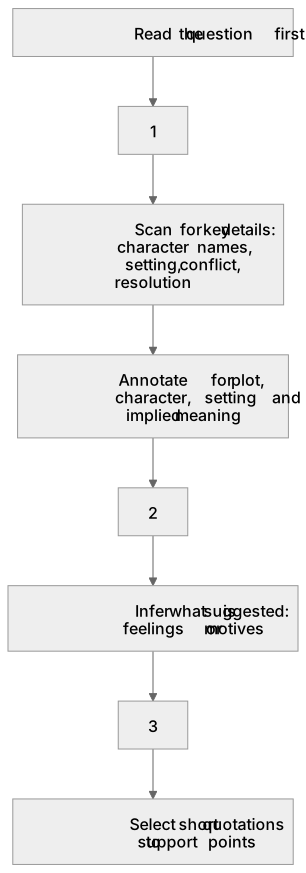
1Box 1
2Box 2
3Box 3
There is more to this lesson
The full lesson goes on to check your understanding and help you earn the marks. Create a free account to carry on, with your progress saved.
A week of Premium from your first lesson · Then the free plan continues · No card, no charge
Test your understanding of Component 1: Fiction and Imaginative Writing - 1.1 Reading: 1.1.1 read and understand a range of prose fiction, including unseen texts
Active recall beats re-reading. Take an instant quiz now to test what you’ve learned and lock it into long-term memory.
A week of Premium from your first lesson · Then the free plan continues · No card, no charge